
How to Win by Drawing Lines
Gerrymandering is the practice of drawing electoral district boundaries to give one political party an unfair advantage. By strategically placing voters into specific districts, politicians engineer election outcomes before votes are cast. The party controlling redistricting can win more seats than their actual share of voters would suggest—sometimes dramatically so.
Gerrymandering has two critical impacts:
- State legislatures: Drawing state legislative districts determines which party controls state government
- U.S. House of Representatives: Drawing congressional districts determines which party holds power in Congress
The technique works through “packing” and “cracking.” Packing concentrates opposition voters into a few districts where they win by overwhelming margins, wasting those extra votes. Cracking spreads remaining opposition voters thinly across many districts, ensuring they can’t form majorities anywhere. Result: a 50-50 purple state can end up with a 70-30 legislature.
Is It in the Constitution?
States control election processes. Article I, Section 4 of the Constitution—the Elections Clause—gives states primary authority to regulate “the Times, Places and Manner of holding Elections” for Congress. This includes drawing congressional district lines. Congress can override state rules, but rarely does.
The 10-year redistricting cycle comes from the Constitution and federal law. Article I, Section 2 (as amended by the Fourteenth Amendment) requires that House representation be based on state population “as determined by a national census conducted within each 10-year period.” Federal statutes—including the Reapportionment Act of 1929 and Census Act (Title 13 U.S. Code)—operationalize this requirement. States must redraw districts after each census to account for population changes and shifts in the number of House seats allocated to each state.
But nothing prohibits mid-decade redistricting. The Constitution and federal law are silent on how often states can redistrict between censuses. The Supreme Court confirmed in LULAC v. Perry (2006) that there’s no federal prohibition on mid-decade redistricting. Some state constitutions ban the practice, but federal law doesn’t.
And partisan gerrymandering is legal. In 2019, the Supreme Court ruled in Rucho v. Common Cause that partisan gerrymandering—no matter how extreme—is a “nonjusticiable political question” beyond federal court authority. Federal judges won’t stop it. The only federal constraint is the Voting Rights Act’s prohibition on racial gerrymandering, but the Supreme Court has made that increasingly difficult to prove.
Where Does This Come From?

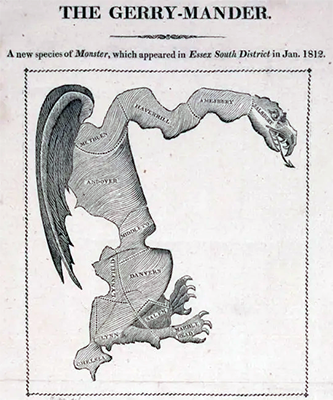
The term comes from Massachusetts Governor Elbridge Gerry, a Founding Father who signed the Declaration of Independence. In 1812, Gerry signed a redistricting bill that redrew state senate districts into bizarre shapes favoring his party. One district in Essex County resembled a salamander. A political cartoon added claws, wings, and fangs, and someone dubbed it a “Gerry-mander.” (Gerry’s name is pronounced with a hard “G” like “Gary,” but “gerrymander” evolved to use a soft “G” like “Jerry.”)
The gerrymander worked. In the 1812 election, Federalists won more votes statewide but Democrats won 29 of 40 state senate seats. Ironically, Gerry lost his own re-election. He became Vice President months later and died in office in 1814.
Gerrymandering predates even Gerry. Patrick Henry tried to gerrymander James Madison out of Congress in 1788. But the 1812 Massachusetts district was so brazen that it gave the practice its name and made it infamous.
The 2025 Redistricting Crisis
In July 2025, Trump called on Republican-controlled state legislatures to redraw congressional maps mid-decade. He posted: “It is now time for the Republicans to play their ‘TRUMP CARD,’ and go for what is called the Nuclear Option.”
Several states responded:
Texas passed a new map designed to flip five seats Republican. Federal courts temporarily blocked it for racial gerrymandering, but the Supreme Court intervened December 4, 2025, allowing Texas to use the map for 2026 elections.
North Carolina redrew its map for the seventh time since 2016. Republicans hold 10 of 14 seats despite winning 50.9% of votes in 2024. The new map targets the one remaining competitive district.
Missouri and Indiana passed new maps to gain Republican seats.
Democratic states retaliated. California voters approved a measure to flip five seats Democratic.
This nationwide mid-decade redistricting is unprecedented. Traditionally, redistricting happened only after the census. Now it’s happening between censuses, before every election, as parties compete to maximize advantage.
The Supreme Court’s Green Light
The 2019 Rucho v. Common Cause decision changed everything. By 5-4, the Supreme Court ruled federal courts lack authority to decide partisan gerrymandering cases. Chief Justice Roberts acknowledged extreme gerrymandering may be “incompatible with democratic principles” but concluded courts had no “manageable standards” to determine when it goes too far.
Justice Kagan’s dissent: “The partisan gerrymanders here debase and dishonor our democracy, turning upside-down the core American idea that all governmental power derives from the people.”
The ruling left remedies to state courts, state legislatures policing themselves, or Congress passing legislation. But it declared open season on partisan gerrymandering at the federal level.
A 2025 Supreme Court decision made things worse. In Alexander v. South Carolina State Conference of the NAACP, the Court made it easier for states to defend racial gerrymandering by claiming it’s partisan gerrymandering. Since racial gerrymandering is illegal but partisan isn’t, gerrymanderers now simply say they targeted Democrats (legal), not Black voters (illegal)—even when the groups overlap.
Why Does It Matter?
Gerrymandering undermines democracy’s basic principle: voters choose representatives. When politicians choose voters instead, elections become predetermined. Voters in gerrymandered districts have no meaningful choice.
The effects compound. When districts are safe for one party, candidates only need to win primaries. This pushes politics toward extremes. Representatives from gerrymandered districts ignore broad public opinion because they face no electoral accountability.
Gerrymandering affects both state and federal power. It determines which party controls state legislatures, which in turn control election rules, abortion laws, voting access, and redistricting itself. It also determines which party controls the U.S. House and influences presidential elections through the Electoral College (See: Electoral College, Chapter 2).
Consider North Carolina: Republicans won 50.9% of statewide votes in 2024 but hold 71.4% of congressional seats. This isn’t democracy—it’s minority rule through map manipulation.
The Supreme Court’s refusal to intervene means there are effectively no limits. A party controlling redistricting can engineer overwhelming legislative majorities from narrow popular vote margins, maintain power even when most voters oppose them, and gerrymander again to ensure they stay in power.
What Would We Lose?
If gerrymandering were eliminated—through independent commissions, mathematical algorithms, or federal standards—the party in power couldn’t lock in majorities for a decade regardless of how voters vote.
But what would we gain? Competitive elections where representatives earn votes. Districts reflecting communities rather than partisan calculations. A Congress accurately representing how Americans voted. Representatives answering to all constituents, not just primary voters in safe districts.
Many democracies have solved this. Canada, Australia, and the UK use independent commissions. Several U.S. states—California, Arizona, Michigan—have adopted similar reforms. These aren’t perfect, but they remove the conflict of interest: politicians drawing their own districts.
The alternative is what we have now: politicians increasingly choosing voters, extreme partisan gerrymandering that’s legal and encouraged, mid-decade re-gerrymandering threatening to make every election a map-drawing contest, and the party winning redistricting dominating legislatures even when they lose the popular vote.
The Supreme Court says this is a “political question” for legislatures and Congress to resolve. But those are the bodies that benefit from gerrymandering. Asking them to police themselves is asking foxes to guard the henhouse.
The Founders couldn’t have imagined computer-assisted map manipulation predicting and controlling election outcomes with precision. They designed a system where voters held power. Gerrymandering inverts that: power holders choose which voters matter.

