
Three Co-Equal Branches
Separation of powers is the principle that government authority should be divided among three distinct branches—legislative, executive, and judicial—each with its own specific powers and responsibilities. No single branch can exercise all governmental power, and each branch has the ability to check and restrain the others. This system is designed to prevent tyranny by ensuring that no person or group can accumulate unlimited authority.
Where Is It in the Constitution?
The Constitution’s structure reflects this division through its first three articles:
Article I, Section 1: “All legislative Powers herein granted shall be vested in a Congress of the United States, which shall consist of a Senate and House of Representatives.”
Article II, Section 1: “The executive Power shall be vested in a President of the United States of America.”
Article III, Section 1: “The judicial Power of the United States shall be vested in one supreme Court, and in such inferior Courts as the Congress may from time to time ordain and establish.”
These vesting clauses are deliberate and absolute. The Constitution doesn’t say legislative powers are “primarily” vested in Congress or that the president “generally” holds executive power. Each branch is given exclusive authority over its constitutional domain.
Where Does This Come From?
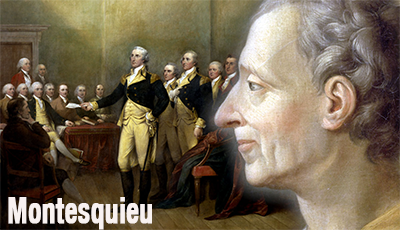
The idea came from Baron Charles de Montesquieu, a French philosopher who published The Spirit of the Laws in 1748. Montesquieu studied the English system and concluded that liberty required dividing power among different branches of government. He warned: “When legislative and executive powers are united in the same person… there can be no liberty.”
The American Founders had just fought a war to escape a British king who held enormous power. They wanted something different—a republic where power was dispersed and controlled. Montesquieu’s theories provided the blueprint. He was the most frequently quoted authority on government in colonial America, cited more than anyone except the Bible.
James Madison, the “Father of the Constitution,” called Montesquieu “the oracle who is always consulted and cited on this subject.” The Founders adapted his ideas to create three truly separate branches, then added checks and balances so each could restrain the others. As Madison wrote in Federalist No. 51: “Ambition must be made to counteract ambition.”
How the System Works
Congress (Legislative Branch) makes the laws. It controls federal spending through the power of the purse—no money can be spent unless Congress appropriates it. Congress can override presidential vetoes with a two-thirds vote in both houses. The Senate confirms or rejects presidential appointments to the Cabinet, federal courts, and other positions. Congress can impeach and remove the president, judges, and other federal officials. It can investigate the executive branch and subpoena documents and witnesses.
The President (Executive Branch) enforces the laws Congress passes. The president commands the military, conducts foreign policy, and appoints federal judges and Cabinet members (with Senate approval). The president can veto legislation, though Congress can override that veto. Importantly, the president cannot make laws, cannot spend money Congress hasn’t appropriated, and cannot refuse to spend money Congress has appropriated.
The Courts (Judicial Branch) interpret the laws and decide whether they comply with the Constitution. Federal judges serve for life during “good behavior” and cannot be fired by the president or Congress except through impeachment. The Supreme Court can declare laws unconstitutional, and lower courts can block executive actions that violate the law or Constitution. Courts cannot make laws or enforce their own rulings—they depend on the executive branch to enforce their decisions and Congress to fund them.
This system only works if each branch jealously guards its own powers and refuses to let the others encroach. Madison explained it this way in Federalist No. 51: “Ambition must be made to counteract ambition.” He wasn’t counting on virtue or good intentions. He was counting on institutional self-interest—each branch protecting its own turf because its members wanted to preserve their own authority and influence.
The beauty of the system is that it turns human nature—specifically, the desire for power—into a safeguard for liberty. Politicians want power. The Constitution gives different politicians power in different branches and then sets them against each other. The result is that no single faction can easily dominate.
When the System Is Tested
The Trump administration has repeatedly tested these boundaries. More than 350 lawsuits have been filed challenging executive actions, and federal judges appointed by presidents of both parties have ruled against the administration numerous times. Understanding these conflicts requires understanding what each branch’s constitutional powers actually are.
The Power of the Purse: The Constitution gives Congress exclusive authority over federal spending. Article I, Section 9 states: “No Money shall be drawn from the Treasury, but in Consequence of Appropriations made by Law.” This means the president cannot spend money Congress hasn’t authorized, and cannot refuse to spend money Congress has allocated.
In 2025, Trump’s Office of Management and Budget ordered a freeze on federal grants and loans—everything from Head Start to farm subsidies—without congressional authorization. Federal courts ruled this violated the Constitution’s separation of powers. A federal judge in Rhode Island rejected the administration’s argument that the president must “align Federal spending and action with the will of the American people as expressed through Presidential priorities,” calling it “constitutionally flawed.” The judge wrote that under the Constitution, the president cannot act unilaterally to redirect congressionally appropriated funds.
Independent Agencies: Congress has created independent agencies—like the National Labor Relations Board—to operate free from direct presidential control. Board members serve fixed terms and can only be removed “for neglect of duty or malfeasance in office, but for no other cause.” This independence is by design: Congress wanted these agencies to resolve disputes fairly, without political interference.
When Trump fired Gwynne Wilcox from the NLRB three years before the end of her term, he violated this principle. The president doesn’t have unlimited power to fire officials Congress has deliberately insulated from political pressure. The separation of powers means Congress can create positions that the president cannot control at will.
Eliminating Agencies: When Trump defunded the U.S. Agency for International Development and transferred its functions to the State Department, he bypassed Congress entirely. But Congress creates agencies, funds them, and determines their missions. The president executes those decisions—he doesn’t get to override them by reorganizing the federal government on his own authority.
Ignoring Court Orders: Perhaps most troubling, the administration has signaled it may not comply with unfavorable court rulings. Vice President Vance stated in 2021: “If I was giving [Trump] one piece of advice… when the courts stop you, stand before the country like Andrew Jackson did, and say, ‘The chief justice has made his ruling. Now let him enforce it.’”
This is a reference to President Andrew Jackson defying a Supreme Court ruling that protected Cherokee land rights—one of the darkest moments in American history, leading directly to the Trail of Tears. If the executive branch refuses to follow court orders, the entire system collapses. Courts have no army. They depend on the executive branch to enforce their rulings. If a president simply ignores judges, there’s no mechanism to compel compliance except impeachment, which requires Congress to act.
When the Checks Fail
Two critical checks on presidential power have collapsed: the Supreme Court and Congress itself.
The Stacked Court: In 2016, when Justice Antonin Scalia died, Senate Majority Leader Mitch McConnell refused to hold hearings or vote on President Obama’s nominee, Merrick Garland, for 293 days. McConnell argued that the American people should have a voice in selecting the next justice through the presidential election. McConnell later called this “the single biggest decision I’ve ever made” and “the most consequential decision I’ve ever made in my entire public career”.
Four years later, when Justice Ruth Bader Ginsburg died just 46 days before the 2020 election, McConnell abandoned his own principle and rushed Amy Coney Barrett’s confirmation through in record time.
Trump appointed three Supreme Court justices: Neil Gorsuch (filling the seat McConnell held open), Brett Kavanaugh, and Amy Coney Barrett. The result is a 6-3 conservative majority that has shown remarkable deference to executive power—specifically Trump’s executive power. The Court has expanded presidential immunity, weakened regulatory agencies, and signaled openness to theories of executive authority that previous Courts rejected. The judicial check on presidential overreach has become unreliable when the president who appointed the justices is the one overreaching.
Congress’s Surrender: Many members of the House appear to have abandoned their constitutional role entirely. They’ve surrendered the power of the purse, allowing the president to redirect or withhold congressionally appropriated funds. They’ve conducted minimal oversight, even as the executive branch openly defies court orders and ignores congressional subpoenas. They’ve chosen party loyalty over institutional responsibility.
The result is that the two checks designed to restrain presidential power—the courts and Congress—are either unwilling or unable to do so. When one party controls both the presidency and Congress, and has shaped the Supreme Court, separation of powers becomes separation in name only.
Congress’s Failure to Act
Beyond the Supreme Court problem, the most striking feature of this period is Congress’s refusal to defend its own powers. Political scientists call this “separation of parties, not powers.” When the same party controls both the executive and legislative branches, institutional self-interest often disappears. Members of Congress prioritize party loyalty over defending their institution’s authority.
Republican members of Congress have remained largely silent as Trump has seized congressional powers. Some privately oppose his actions but publicly stay quiet, hoping the courts will strike them down so they don’t have to take a political risk. Others genuinely support expanding executive power—at least when their party holds the presidency.
The question today is whether Congress has the will to defend its own powers. With narrow majorities and deep partisan divisions, Congress may lack either the votes or the political courage to check executive actions that clearly exceed presidential authority.
Why Does It Matter?
Separation of powers is the foundation of American democracy. Without it, democracy itself cannot survive. When one person holds all governmental power—making laws, enforcing them, and judging disputes—that person becomes a tyrant.
The Founders designed the American system to prevent this by making each branch dependent on the others while giving each the tools to resist encroachment. This isn’t just a nice idea or a procedural formality. It’s the essential protection against authoritarianism.
If the president can spend or refuse to spend money without congressional approval, Congress becomes irrelevant. If the president can ignore court orders, judges become powerless. If the president can fire officials who are supposed to be independent, those positions lose their independence. If Congress won’t defend its own authority, the legislative branch becomes a rubber stamp.
The system requires each branch to jealously guard its powers. It requires judges willing to rule against presidents. It requires members of Congress willing to defend their institution even when it means opposing a president from their own party. It requires presidents who accept that they don’t have unlimited power.
When any of these break down, the three equal branches stop being equal. One branch expands to swallow the others. And we move closer to what the Founders feared most: all power concentrated in a single set of hands. Trampling on the separation of powers is one of the key elements threatening democracy itself.
What Would We Lose?
If we abandon separation of powers, we’d return to something like the system the Founders rejected: monarchy or autocracy, where one person or faction holds all the power. We’d lose the ability to check abuses. We’d lose the protection that comes from forcing different institutions to negotiate and compromise. We’d lose accountability, because when one branch holds all power, there’s no one left to hold it responsible.
The alternative isn’t necessarily immediate dictatorship. Many modern governments function with weaker separation of powers. Parliamentary systems, for example, combine legislative and executive functions in a prime minister who leads the majority party in parliament. But those systems have other checks: votes of no confidence, coalition governments, stronger political parties that can discipline their members.
The American system was designed with separation of powers as its core protection against tyranny. Without it, we’d need to build entirely new safeguards. Or we’d need to accept that we’re trading liberty for efficiency—that having one person make all the decisions is simpler, faster, and perhaps more effective than making three branches negotiate.
That’s the fundamental question: Is efficiency worth the loss of freedom? Montesquieu and the Founders decided it wasn’t. We’re being asked to decide again.

