
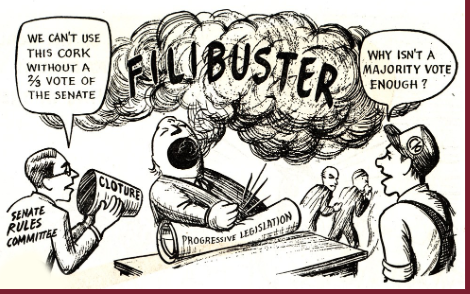
Talking a Bill to Death
A filibuster is a Senate tactic that allows senators to delay or block a vote on legislation by extending debate indefinitely. The term itself comes from the Dutch word vrijbuiter (meaning “freebooter”—someone who takes loot) by way of Spanish filibustero, which described pirates raiding Caribbean islands. By the 1890s, the word was applied to legislators who “pirated” Senate proceedings by talking endlessly to obstruct business—a fitting metaphor for procedural hijacking.
To end a filibuster and bring a measure to a vote, the Senate must invoke “cloture”—a procedure that requires 60 votes out of 100 senators. This means that even if 59 senators support a bill, a minority of 41 senators can block it indefinitely simply by refusing to end debate.
The filibuster exists because of Senate rules, not constitutional mandate. The Constitution says nothing about filibusters or requiring 60 votes to pass legislation. In fact, the Constitution explicitly specifies only five situations requiring supermajority votes: conviction on impeachment (two-thirds), treaty ratification (two-thirds), expelling a member of Congress (two-thirds), overriding presidential vetoes (two-thirds), and proposing constitutional amendments (two-thirds). For everything else, the Constitution implies that a simple majority should suffice.
Where Is It in the Constitution?
It’s not. Article I, Section 5 of the Constitution grants each chamber of Congress the power to “determine the Rules of its Proceedings.” The Senate has chosen to adopt rules that allow unlimited debate unless 60 senators vote to end it.
The relevant rule is Senate Rule XXII, which states that “three-fifths of the Senators duly chosen and sworn” (60 votes when there are no vacancies) can invoke cloture to limit debate. This rule can be changed by the Senate itself—but changing it typically requires either a two-thirds vote or invoking the “nuclear option,” where a simple majority reinterprets the rules through parliamentary procedure.
Where Does This Come From?
The filibuster wasn’t part of the Founders’ original vision. It emerged almost by accident in 1806, when Vice President Aaron Burr advised the Senate to streamline its rulebook by removing redundant provisions. One rule he flagged allowed a simple majority to end debate. Senators removed it, never imagining they’d just created the possibility for unlimited debate and filibusters.
As the Senate grew busier in the late 1800s and early 1900s, a single senator’s ability to monopolize floor time became increasingly disruptive. In 1917, with World War I raging and the Senate paralyzed by filibusters, President Woodrow Wilson pushed for reform. Wilson denounced filibustering senators as “a little group of willful men, representing no opinion but their own, [who] have rendered the great Government of the United States helpless and contemptible.”
On March 8, 1917, the Senate adopted Rule XXII, establishing cloture for the first time. The rule allowed ending debate with a two-thirds majority of senators present and voting. In 1975, the Senate reduced the threshold to three-fifths (60 votes), making it somewhat easier to overcome filibusters.
The Civil Rights Connection
No discussion of the filibuster is complete without acknowledging its darkest chapter: its systematic use to block civil rights legislation.
For decades, Southern Democrats used filibusters to prevent federal laws ensuring equal rights for African Americans. They blocked anti-lynching bills, voting rights protections, and desegregation measures. In 1957, Senator Strom Thurmond of South Carolina conducted the longest individual filibuster in Senate history: 24 hours and 18 minutes against the Civil Rights Act of 1957.
The filibuster of the Civil Rights Act of 1964 lasted 60 days. Southern senators took turns holding the floor, determined to kill the most comprehensive civil rights legislation since Reconstruction. But this time, supporters finally secured the necessary two-thirds vote for cloture.
This history matters. The filibuster’s defenders often describe it as a safeguard for minority rights and deliberative democracy. But for much of American history, it was used specifically to deny minority rights—to block legislation that would extend basic constitutional protections to Black Americans.
How Does It Work?
Under current Senate rules, almost any legislation can be filibustered. To overcome a filibuster, supporters must file a cloture motion signed by at least 16 senators. The Senate waits two days before voting on the cloture motion. If 60 senators vote for cloture, debate is limited to an additional 30 hours, after which a final vote must occur.
Importantly, there are exceptions. Certain types of legislation cannot be filibustered: budget reconciliation bills, fast-track trade agreements, War Powers Resolutions, and Congressional Review Act resolutions.
In modern practice, filibusters rarely involve actual marathon speeches. Since the 1970s, the mere threat of a filibuster has been enough to halt legislation. Senators simply signal their intent to filibuster, and Senate leaders move on to other business rather than waste time on a doomed vote.
Trump and the 2025 Shutdown
In October 2025, during a government shutdown that stretched past 30 days, President Trump called on Senate Republicans to eliminate the filibuster using the “nuclear option.” He posted on Truth Social: “It is now time for the Republicans to play their ‘TRUMP CARD,’ and go for what is called the Nuclear Option — Get rid of the Filibuster, and get rid of it, NOW!”
Trump’s frustration was clear: Republicans held 53 seats in the Senate but needed 60 votes to pass a continuing resolution to fund the government. Democrats were blocking the measure, demanding negotiations over expiring health insurance subsidies under the Affordable Care Act.
Senate Majority Leader John Thune immediately rejected Trump’s demand. His spokesman stated: “Leader Thune’s position on the importance of the legislative filibuster is unchanged.” Other Republican senators followed suit. Senator John Curtis of Utah posted: “The filibuster forces us to find common ground in the Senate. Power changes hands, but principles shouldn’t. I’m a firm no on eliminating it.”
Republicans refused for a pragmatic reason: they remembered being in the minority. They knew that if they eliminated the filibuster while in power, Democrats would use that same rule change against them when Democrats regained control.
Why Does It Matter?
The filibuster fundamentally changes how the Senate operates. Instead of simple majority rule, it creates a 60-vote threshold for most legislation.
The Constitution already protects minority interests through the Senate itself. The House of Representatives is the majoritarian body—it represents population directly, with frequent elections allowing voters to quickly change direction. The Senate was designed as a different kind of check: six-year staggered terms mean that even if a sudden passion sweeps the country, it takes years to replace the entire Senate. Every state gets two senators regardless of population, giving small states equal voice with large states. This structure already protects minority interests and slows hasty legislation.
Adding a 60-vote requirement on top of this creates a double protection—or, critics argue, a double obstacle to majority rule. It means that senators representing a minority of Americans can block legislation supported by senators representing the vast majority. Consider: The 41 senators needed to sustain a filibuster could, in theory, represent as little as 11% of the U.S. population if they come from the smallest states.
Defenders argue the filibuster serves important purposes:
The famous (though possibly apocryphal) story has George Washington explaining to Thomas Jefferson over breakfast why the Founders created the Senate. Jefferson supposedly asked why they needed a Senate in addition to the House. Washington pointed to Jefferson’s saucer of tea and said: “We pour our legislation into the senatorial saucer to cool it.”
Senator Lisa Murkowski echoed this metaphor in 2020: “I see the benefit of being more methodical, of being that cooling saucer in the process of governance.”
James Madison wrote that without the Senate’s restraint, Congress would “yield to the impulse of sudden and violent passions, and to be seduced by factious leaders into intemperate and pernicious resolutions.”
Modern defenders argue the filibuster:
- Forces compromise and bipartisan cooperation
- Prevents the tyranny of the majority
- Slows down hasty legislation, encouraging deliberation
- Protects the Senate’s distinctive character as a more deliberative body
Critics respond:
Senator Dick Durbin asked in 2020: “Why is this such an empty chamber? Why all these empty desks when so many things are needed to be done in America? Because we have stopped legislating. We have stopped debating. We have stopped amending.”
The filibuster’s critics argue it:
- Enables minority rule rather than protecting minority rights
- Creates gridlock where important legislation dies not from lack of majority support but from procedural obstruction
- Wasn’t what the Founders intended—they specified supermajorities only for specific actions
- Has a troubling history of blocking civil rights and progressive reforms
- No longer produces compromise in an era of extreme partisan polarization
What Would We Lose?
If the Senate eliminated the filibuster, legislation would pass with simple majorities. When one party controls the presidency and both chambers of Congress, they could enact their agenda without negotiating with the opposition.
Critics argue this would lead to wild policy swings as control shifts between parties. Laws passed in one Congress would be repealed in the next. Instability would replace deliberation.
Defenders of eliminating the filibuster respond that this is how democracy is supposed to work. Voters choose a party to govern. That party implements its platform. If voters don’t like the results, they elect a different party. Accountability requires that elected majorities can actually govern.
The alternative—the current system—means that neither party can fully implement its agenda even when voters give them control of government. Voters elect leaders who promise change, then watch as the Senate’s 60-vote requirement makes change impossible.
The filibuster was designed to encourage deliberation and compromise. But in an era of deep partisan polarization and zero interest in good-faith negotiation, it may no longer serve that purpose. The question is whether a rule meant to cool passions and force consensus can function in a Senate where consensus has become impossible.


Leave a Reply